
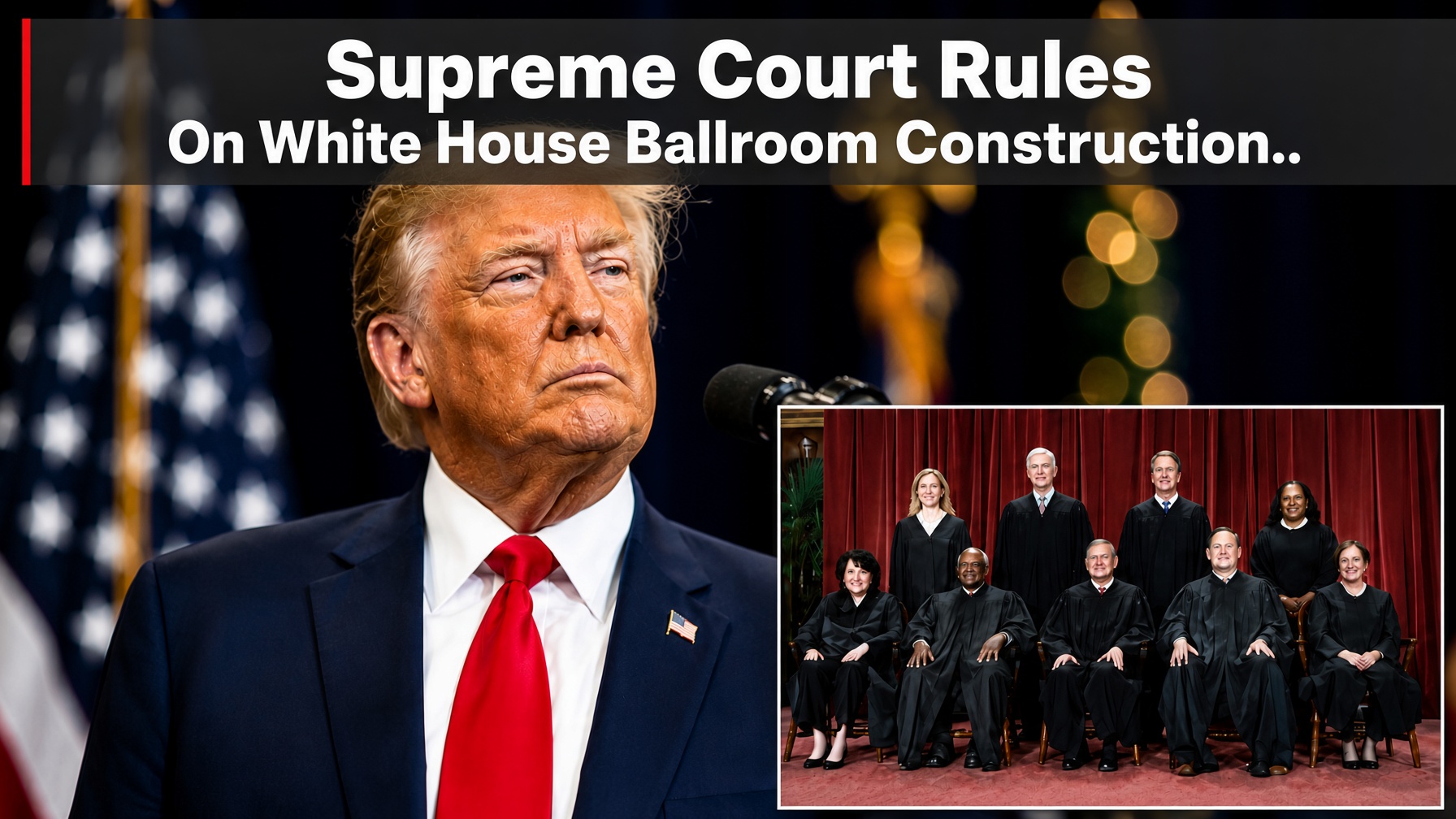
Just about everything President Donald Trump has done during his nearly two years back in the White House has been subjected to left-wing lawfare from various groups and Democratic state officials.
Overall, Trump’s record against these legal efforts to tie up his agenda is pretty good, and he won another court battle on Monday.
The Supreme Court on Monday allowed construction of the Trump administration’s new White House ballroom to continue while litigation over the project proceeds.
By a 5-4 vote, the justices paused a ruling from a federal judge in Washington that would have blocked above-ground construction of the ballroom.
In an unsigned, eight-page opinion, the majority emphasized that it was not deciding whether the project itself is lawful.
Instead, the court said the group challenging the construction likely lacks standing—the legal requirement that a plaintiff demonstrate sufficient injury to bring a lawsuit.
The decision came 10 days after Chief Justice John Roberts temporarily put the lower court’s ruling on hold while the Supreme Court considered the administration’s request.
Roberts ultimately joined the court’s three liberal justices in dissent.
The dissenters argued that the construction “is likely unlawful” and said the majority’s ruling represented “no victory for the separation of powers.”
Senior U.S. District Judge Richard Leon’s order had not taken effect because of the Supreme Court’s temporary intervention.
The administration told the justices in an Aug. 13 filing that the overall ballroom project was already “65% complete in its entirety” and progressing rapidly, raising the possibility that construction could be largely or entirely finished before the legal dispute is finally resolved, according to SCOTUSblog.
The National Trust for Historic Preservation, a private nonprofit organization dedicated to protecting historic sites, filed the lawsuit in federal court in Washington in December.
The group asked U.S. District Judge Richard Leon to halt construction until the National Capital Planning Commission and the Commission of Fine Arts could review the ballroom plans, the planning commission could approve them, and Congress could authorize the project.
On March 31, Leon issued an order temporarily blocking above-ground construction while allowing underground work—including construction related to bomb shelters and bunkers—to continue.
He also permitted above-ground work considered necessary for safety and security.
The U.S. Court of Appeals for the District of Columbia Circuit paused Leon’s ruling before it took effect while considering the administration’s appeal.
On Aug. 7, a divided three-judge panel upheld Leon’s decision but gave the federal government 14 days to seek relief from the Supreme Court.
Writing for the 2-1 majority, Judges Patricia Millett and Bradley Garcia said Congress has the authority to regulate construction and demolition involving White House structures and noted that lawmakers had not appropriated money for the ballroom project.
The majority also concluded that allowing construction to proceed could cause permanent harm to members of the National Trust because the completed structure could result in “irreversible historical-preservation, architectural, and visual damage.”
Judge Neomi Rao dissented, arguing that the National Trust lacked standing to challenge the project.
She also maintained that the president’s authority to make improvements to the presidential residence likely extends to construction of the ballroom.
The Trump administration, on Aug. 13, asked the Supreme Court to step in and temporarily block Leon’s ruling, calling it “extraordinary and unlawful.”
U.S. Solicitor General D. John Sauer told the high court that Leon’s ruling would “halt the ongoing construction of the integrated military complex, including a totally secure ballroom space, at the East Wing of the White House, which is vitally required by national security.”
The administration echoed Rao’s line of reasoning, with Sauer telling the justices that the plaintiffs lacked legal standing to file a lawsuit seeking to stop the project.
He also argued that Congress has already given Trump—and other presidents—the authority “to make ‘alteration[s]’ and ‘improvement[s]’ to the White House” and has “broadly authorized the Executive to construct buildings in national parks.”