
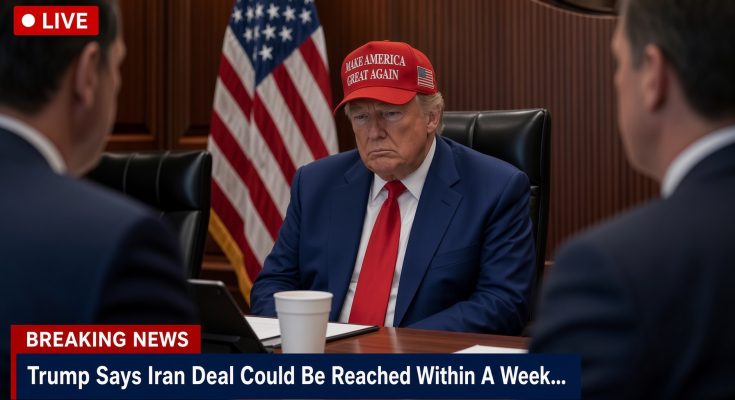
President Donald Trump said the United States and Iran could reach an agreement within the next week to extend the current ceasefire and establish terms for reopening the strategically vital Strait of Hormuz, expressing optimism that diplomatic efforts remain alive despite tensions and setbacks.
In a telephone interview with ABC News chief Washington correspondent Jonathan Karl, Trump described the negotiations as “looking good” and said he believed the two sides were making progress. The president acknowledged that a complication had emerged earlier in the day but claimed he had intervened quickly to prevent the disagreement from derailing the broader discussions.
“There was a little glitch today,” Trump said, adding that he believed the problem had been resolved.
According to Trump, the latest dispute was connected to Israeli military activity involving Lebanon and tensions between Israel and Hezbollah. He said he communicated with Israeli Prime Minister Benjamin Netanyahu and sought to prevent further escalation, while also claiming that Hezbollah agreed to stop firing at Israel.
Trump portrayed the diplomatic effort as potentially more consequential than continued military confrontation. Rather than pursuing an indefinite cycle of escalation, he argued, a negotiated agreement with Tehran could provide a more durable outcome.
“A peace agreement with Iran could be even better than a military victory,” Trump said.
The president nevertheless acknowledged that reaching a comprehensive agreement would be difficult. Relations between Washington and Tehran have been defined by decades of hostility, competing security interests, and disagreements over Iran’s nuclear program and regional influence.
“It’s not a simple thing,” Trump said, describing Iran as a large and powerful country and emphasizing the depth of the mistrust between the two governments.
Despite those challenges, Trump said he believed negotiations could move quickly. Asked when an understanding concerning the Strait of Hormuz might be reached, he suggested that an agreement could come within roughly a week, while cautioning that several unresolved issues remained.
“I still have to get a few more points,” he said.
Talks Face Uncertainty
Trump’s comments followed a period of uncertainty after Iran reportedly indicated that communications with Washington had been suspended amid anger over Israeli military actions in Lebanon. The development raised questions about whether the broader diplomatic process was beginning to unravel.
Trump subsequently sought to reassure the public that negotiations had not collapsed. In a social media statement, he said discussions with Iran were continuing and described them as moving forward at a rapid pace.
Iran, however, had not publicly confirmed Trump’s characterization of the talks, leaving uncertainty over the precise status of negotiations.
Trump also claimed he had personally intervened to prevent further escalation between Israel and Hezbollah. He said he spoke with Netanyahu and secured assurances that Israeli forces would not enter Beirut, while also claiming that Hezbollah had agreed through intermediaries to halt attacks.
Those claims came amid continuing regional tensions and reports of renewed military activity involving Israel and Lebanon.
At the center of the diplomatic effort is the Strait of Hormuz, one of the world’s most strategically important waterways. The narrow passage connects the Persian Gulf with the Gulf of Oman and serves as a crucial route for international energy shipments.
Any prolonged disruption of the strait could have significant consequences for global oil supplies, energy prices, shipping, and international trade.
Trump’s latest comments therefore carry implications far beyond the immediate U.S.-Iran dispute. If negotiations succeed, an agreement could potentially ease regional tensions and restore greater stability to a critical global trade route.
For now, however, the path toward a lasting agreement remains uncertain. Trump is signaling confidence, but significant issues remain unresolved, and the coming days could determine whether the current ceasefire develops into a broader diplomatic settlement—or another temporary pause in a long-running conflict.